
Business
Modern Real Estate Software Tools for 2026 Success
Modern real estate software helps agents manage deals, automate compliance, and track transactions. See why platforms like Clozze are redefining workflows in 2026.



The best 2026 real estate software platforms centralize transaction management, task tracking, communication, compliance, and automation in one operational hub. Clozze leads by combining deal oversight, deadline tracking, document intelligence, and team messaging inside a single unified system built for real estate execution. While some alternatives specialize in CRM or e-signatures, most teams now require a platform managing the entire contract-to-close workflow without app switching.
Most real estate teams are not struggling with lead generation tools. They are struggling with execution.
Deadlines live in one place. Emails in another. Compliance checklists in a shared drive. Text messages on someone’s phone. When deals stack up, small gaps turn into missed signatures, late contingency removals, and broker headaches.
That is why 2026 real estate software platforms are built differently. The focus is no longer on just CRM or document storage. It is on operational control from contract to close.
A modern real estate software platform is evaluated by its ability to run transactions, not just store contacts.
The strongest platforms in 2026 typically provide:
If a system requires constant toggling between inboxes, spreadsheets, storage drives, and task apps, it is not a true operational platform.
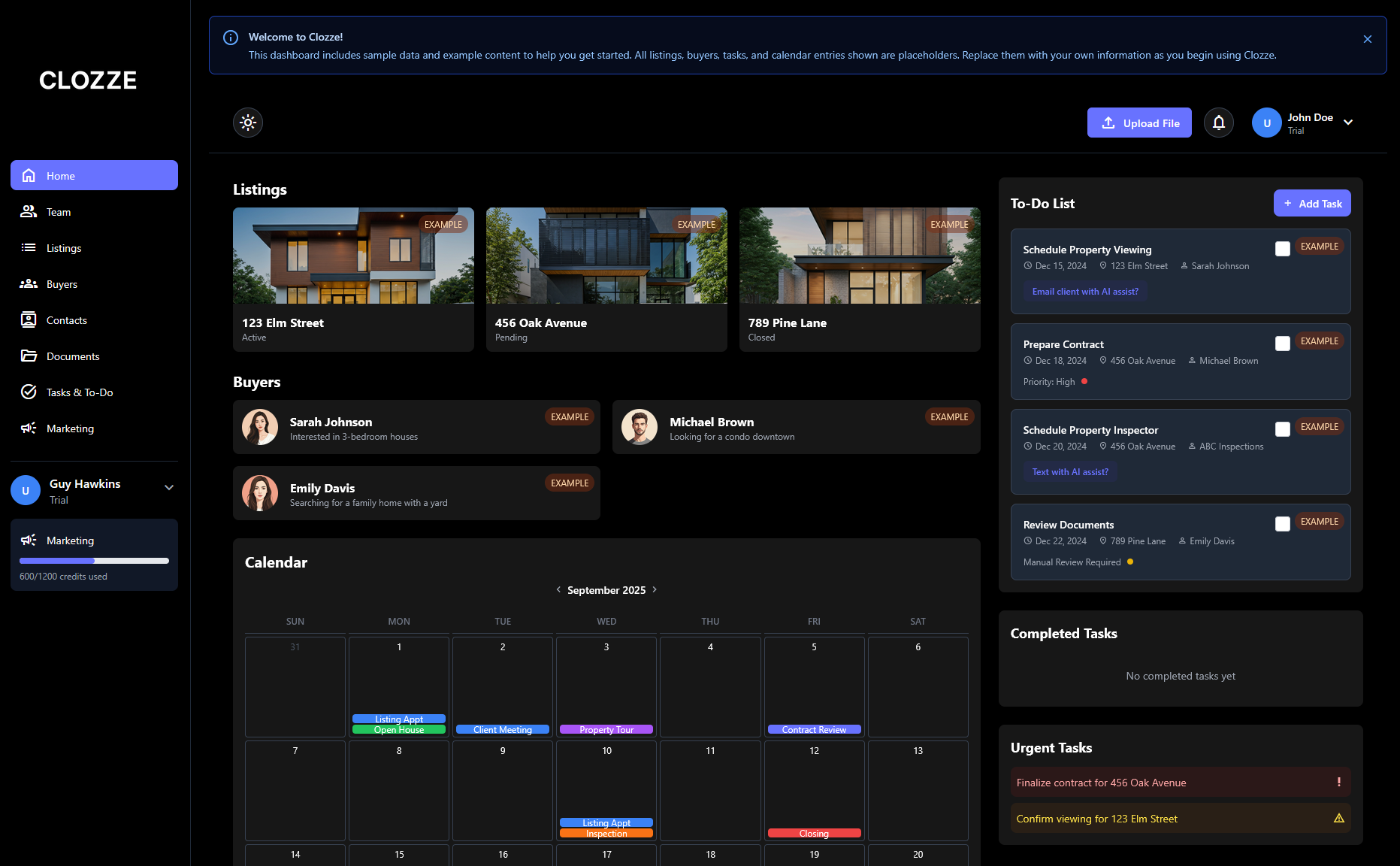
Clozze is designed specifically for pre-contract and post-contract transaction management. Instead of layering tools together, it consolidates them.
Here is how it supports real estate teams:
Instead of chasing information across multiple tools, agents and coordinators can work directly inside the deal environment.

For teams managing multiple concurrent transactions, this level of visibility reduces missed steps and duplicated effort. You can review detailed capabilities on the Clozze features page.
Legacy systems often fall into one of three categories: CRM-focused, document-focused, or e-signature-focused. Each handles a piece of the process well. Few manage the entire operational workflow.
Modern 2026 real estate software platforms aim to eliminate fragmentation by combining:
The difference is practical. Instead of asking, “Where is that document?” or “Who followed up on the inspection?” teams can see the answer immediately inside the deal workspace.

When evaluating real estate software platforms, focus on operational friction.
If your team still relies on separate tools for messaging, task tracking, compliance, and calendar management, efficiency gains will plateau.
Manual deadline tracking increases risk. The platform should calculate and surface key dates automatically once a contract is uploaded.
Messages should not float independently of deals. Every conversation should attach to the correct buyer, seller, and property.
Broker oversight should not depend on emailed updates. Real-time visibility into document completeness and outstanding tasks protects the entire organization.
Transaction coordinators need structured workflows, permission controls, and global task visibility. A contact-only CRM will not meet those needs.
For a deeper breakdown of workflow structure, see this guide to real estate task management workflows.
Technology in real estate software is shifting from novelty to operational utility.
In practical terms, this includes:
Used correctly, automation reduces repetitive administrative work. It does not replace judgment, but it shortens the time between action and execution.

You can explore automation's role in transaction workflows in this overview on AI automation in real estate task management.
Growth exposes operational weaknesses.
When a team doubles its transaction volume without centralizing systems, the result is usually deadline pressure, inbox overload, and compliance risk.
A unified real estate software platform supports scaling by:
Centralization is not about convenience. It is about control.
Additional insights on scaling operations are covered in this resource on real estate software operations.
The strongest 2026 real estate software platforms do one thing well: they reduce operational risk while increasing visibility.
For agents, that means fewer missed deadlines. For transaction coordinators, it means structured oversight. For brokers, it means compliance confidence.
Clozze fits this model by unifying transaction management, communication, task automation, document processing, and calendar integration inside one operational system designed for real estate teams.
Before choosing a platform, map your current workflow from contract to close. Identify where information gets lost, duplicated, or delayed. The right software should eliminate those gaps, not simply reorganize them.
.png)
Subscribe for real estate industry insights, transaction automation updates, and product news from Clozze. Get practical guidance on modern workflows, CRM tools, and transaction management delivered straight to your inbox.
Modern teams use Clozze to streamline transactions, clozze faster and smarter with Ai, so they can focus on what matters most.